See historic events for any day of the year by entering the date below. Why not try your birthday?

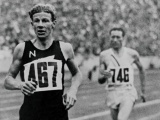
Jack Lovelock won New Zealand's first Olympic track gold medal before Adolf Hitler and a crowd of 110,000 at the 1936 Berlin Olympics. He led the 1500-metres field home in a world record time of 3:47.8.
In the lead-up to the 1936 Games Lovelock seriously considered competing in the 5000 m instead of the 1500 m. He appeared to have made up his mind by 1 July 1936 when he wrote to Harry Amos, secretary of the New Zealand Olympic Games Association, and advised that he had decided to concentrate on the 1500 m. But in the days before the event the media continued to report that Lovelock was wrestling with the decision. Arthur Porritt, the team manager in Berlin, recalled that Lovelock even turned up for the 5000-m heats. After seeking advice from his coach, Bill Thomas, who declined to take responsibility, Lovelock reportedly turned to Porritt - who advised him to get dressed.
The field for the 1500-m final included many of the world's best middle-distance runners, whom Lovelock had competed against over the years: Eric Ny (Sweden), Jerry Cornes (UK), Glen Cunningham (US), Gene Venzke (US) and Luigi Beccali (Italy), who had won gold in the 1500 m at the 1932 Los Angeles Olympics, when Lovelock finished seventh.
Lovelock ran strategically. At the start he positioned himself inside Cunningham and kept with him for much of the race. As they came to the final lap Ny was leading. Lovelock surged up to his shoulder and Cunningham followed. Then, with 300 m to go, Lovelock put on a tremendous sprint. His dramatic finish famously caused the BBC commentator, 1924 sprint gold-medallist Harold Abrahams, to forget his broadcasting etiquette: 'My God, he's done it! Jack! Come on! ... He wins! He's won! Hooray!' Lovelock's time of 3:47.8 was a new world record for the 1500 m and made the 4-minute mile seem a real possibility (another 110 m at the same pace would have resulted in a 4:02-minute mile).
The head of Germany's Olympic Committee, Theodor Lewald, presented Lovelock with his gold medal. He was also given a year-old seedling of a Black Forest oak tree, a symbol of Germany presented to gold medal winners. Lovelock gave it to team-mate Ces Matthews, who was returning to New Zealand. By the time it arrived it was in poor condition, but the curator of the Christchurch Botanical Gardens, James McPherson, nursed it back to health. In 1941 it was planted at Timaru Boys' High School, where it is now a large tree - known as ‘Lovelock's oak'.
Image: Jack Lovelock running at the Berlin Olympics